Home › Services
Concrete removal in Baton Rouge for driveways, patios, walks and old slabs
A driveway split down the middle, a patio that has tipped back toward the house, a walk lifted by a live oak root, or a bare slab left where a shed used to stand: every one of these ends with the concrete broken into manageable pieces, loaded out, and the ground underneath made ready for whatever replaces it. What makes the job harder or easier is hidden: how thick the pour is, whether steel runs through it, and what has to survive beside it. This page explains how removal is done across Baton Rouge and the Capital Region, where the rubble ends up, and what a contractor looks at before pricing it. When you are ready, send the address through the contact page.
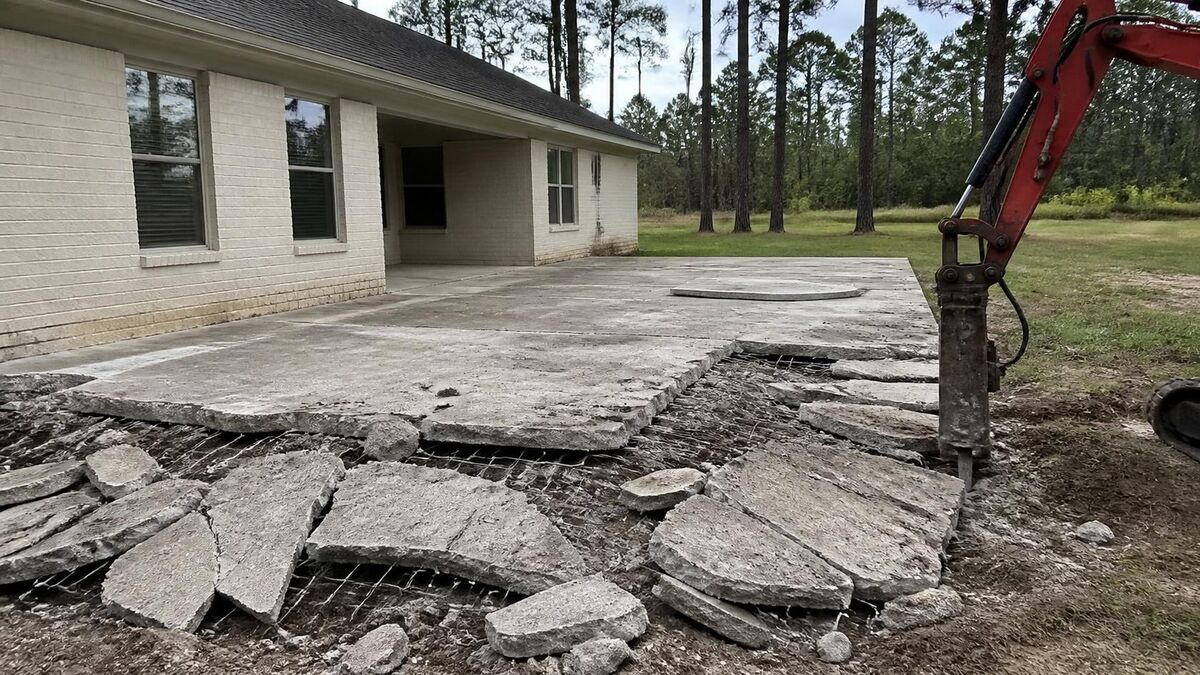
The concrete homeowners here most often want gone
Most requests in this part of Louisiana are not dramatic. They are the flatwork around an ordinary house that has cracked, settled or simply outlived its purpose. Some owners are replacing a driveway before selling; others need an old pad cleared before an addition goes in.
- Driveways and the wide parking pads poured beside them, including ones split into slabs that have shifted at the joints.
- Back patios, porch slabs and the small pads under grills, air conditioning units and generators.
- Front walks and side paths, often pushed up by roots from oaks and pines planted decades ago.
- Concrete steps and stoops that have pulled away from the house or cracked through.
- Leftover slabs and footings where a shed, carport, workshop or barn once stood.
Why flatwork cracks and sinks on Capital Region clay
The heavy clay under much of the Baton Rouge area swells when it soaks up rain and shrinks back when a dry spell pulls the moisture out. A slab resting on that ground rides up and down with it, and a pour never moves evenly. One corner dries out under the sun while the side near a downspout stays wet, so the concrete bends, then cracks along the weakest line it can find.
Flat land and slow drainage make it worse. Water that sits along the edge of a driveway softens the soil there first, and the edge drops while the middle holds. Tree roots push from below, and a heavy truck parked on a thin section can snap it outright.
How the concrete actually gets broken up
There is no single method. Equipment is chosen by the volume and thickness of the slab and by its distance from the home, the road or anything easily damaged.
- An electric or air-powered breaker, the tool most people call a jackhammer, handles medium jobs and tight corners along foundations.
- A skid steer or compact track loader fitted with a hydraulic hammer chews through driveways and patios quickly and then loads the pieces with a bucket.
- A mini excavator with a breaker or a thumb can pry up slabs that are already cracked into plates, lifting them rather than pounding them.
- On thick or heavily reinforced pours, saw cuts are sometimes made first so the slab breaks into blocks of a predictable size.
Thickness and steel decide how hard the job is
Two driveways that look identical from the street can take very different effort to remove. Residential flatwork varies a lot in depth, and older pours in particular were often placed by eye. A slab may be thin in the middle and much thicker at the edges, where the builder dug a turned-down lip to stiffen it. Footings under steps and old posts can run far deeper than the surface suggests.
Reinforcement is the other unknown. Some slabs have no steel at all and shatter cleanly. Many have welded wire mesh, which holds broken chunks together like a net, so every piece has to be cut free. Others carry rebar on a grid, which takes longer to break and adds a step to separate the metal before the concrete can be recycled.
A careful contractor often breaks a small test hole before committing to a method, so a surprise rebar mat gets discussed early.
Saw cutting a clean line where some concrete stays
Partial removal is common. You might keep the garage slab and replace only the driveway, or save the first section of a walk and rebuild the rest. In those cases the line between old and new is cut with a walk-behind or handheld concrete saw before any breaking starts.
The cut gives a straight, square face for the new pour to meet, and it stops cracks from running from the broken section into the part you are keeping. Saws usually run wet to hold down dust, leaving a gray slurry that should be rinsed away from drains. A saw cut through mesh or rebar also severs the steel at the line, so the hammer does not drag reinforcement out of the slab that stays.
Protecting the house, the lawn and everything nearby
Most of the risk on a removal job is not to the concrete coming out. It is to whatever sits next to it, above it or below it. A good crew plans for that before the first swing.
- The house foundation and brick veneer, which can be chipped or cracked if a breaker works too close without a saw cut first.
- The garage slab and any door threshold the driveway butts against.
- Sprinkler lines, landscape lighting wire and drain pipes that were run under or along the slab.
- Buried gas, water, electric and cable lines, which is why the contractor calls Louisiana 811 to have public utilities marked before any digging.
- Tree roots that a new pour will have to coexist with, and the lawn the loader will roll across.
- The curb, the street and the apron at the end of the driveway, where the city-parish may have its own say about how the connection is rebuilt.
A typical driveway removal, step by step
Details shift from job to job, but the work on an ordinary residential driveway tends to follow this order.
- Walk the site, measure the area, check for steel and decide where any saw cuts go.
- Request utility marks through Louisiana 811 and locate private lines such as sprinklers.
- Set protection: plywood or mats over lawn routes, barriers at the street and covers on nearby windows if needed.
- Make the saw cuts at the house, the garage or wherever concrete is staying.
- Break the slab into pieces a loader or a person can handle, cutting mesh and rebar free as it goes.
- Load the broken concrete into a truck or a roll-off container, keeping it as clean as possible.
- Strip any loose base, roots or soft soil the replacement contractor wants gone, then rough grade.
Where the broken concrete and steel end up
Clean concrete is too useful to bury. In the Baton Rouge area, as in most places, much of it goes to a recycler that crushes it into aggregate used as base under roads, parking areas and new slabs. Recyclers generally want the load free of dirt, wood, trash and large tangles of metal, so the way a crew sorts on site affects where a load can go and what it costs to drop off.
Rebar and wire mesh are pulled out and sent for scrap. Anything that cannot be recycled, such as concrete mixed with soil and roots or bits of old asphalt, goes to a landfill or a transfer station.
The base under the slab and getting ready for the new pour
Once the concrete is gone, you finally see what it was sitting on. Sometimes that is a layer of crushed stone or old shell that is still in good shape. Often it is bare clay, sometimes wet and pumping under foot, with a few low spots where water collected for years. That subgrade dictates the prep the follow-on builder faces before setting forms for new concrete.
Some removal jobs stop at the old concrete. Others include stripping soft soil, bringing in select fill or crushed base, and compacting it so the replacement has a firm, even bed. Make sure the removal proposal and the new concrete proposal agree on who does this, so nobody shows up expecting the other one to have done it.
Removing a full slab under a house that is being torn down is part of the house demolition work, and decking around a pool is handled with the pool removal job.
What moves the price of concrete removal
No two removal jobs are priced the same way, and a contractor needs to see the concrete before quoting a number. These are the factors that weigh most.
- Total area and the actual thickness, including any thickened edges, steps and buried footings.
- Reinforcement: plain concrete breaks fastest, mesh adds cutting, and a heavy rebar grid adds the most labor.
- Access for equipment, such as a gate wide enough for a skid steer or a patio reachable only by wheelbarrow.
- How much saw cutting is needed to protect the concrete, brick or structures that stay.
- Trucking distance and disposal or recycling charges for the load.
- Base work after removal: stripping soft soil, adding fill, compacting and grading for drainage.
- Repairs to the lawn route, and any permit the city-parish or parish requires for work at the street.
What a complete removal proposal should spell out
A clear proposal saves arguments later. Look for the exact areas being removed, marked on a sketch or photo, and where every saw cut falls. It should say how the broken concrete and steel will be disposed of, who handles utility marking, and how the lawn and driveway approach will be protected. It should also state what the ground will look like when the crew leaves: rough graded, base installed, or simply cleared.
If the slab came from a structure being taken down, the garage and shed demolition page covers that side of the work. For notes on local conditions in the city itself, see the Baton Rouge page or the full list of areas served.
Concrete removal in Baton Rouge for driveways — common questions
Is demolishing a backyard patio a realistic DIY project?
A thin patio with no steel can be broken by a determined homeowner with a rented breaker and a lot of patience. The hard parts come after: concrete is far heavier than people expect, it has to go somewhere that will accept it, and mesh inside the slab turns every chunk into a tangle. Thick pours, steps tied to the house and anything near a foundation are better left to a crew with a saw and a machine. Call Louisiana 811 before digging below the slab.
How many days does driveway concrete removal usually take?
A standard one- or two-car drive is commonly broken out and trucked off within a day or two after equipment shows up, though that reflects how such jobs usually go rather than a commitment. Heavy rebar, thick edges, a long haul to the recycler, rain that turns the yard to mud, or base work after removal can stretch it. The bigger delay is usually scheduling: utility marks, coordinating with the contractor pouring the new driveway, and any city-parish review of work at the street.
Is a permit needed to pull out a driveway in Baton Rouge?
Removing flatwork on private property is often simpler than taking down a building, but the answer depends on where the work is. Work that touches the curb, the street apron or the public sidewalk is the piece most likely to involve the city-parish, and a new driveway connection may need its own approval. Parishes and cities outside East Baton Rouge run their own offices with their own rules, and a homeowners association may have a say too. The contractor should confirm the current requirements before scheduling.
Is broken concrete recycled or just dumped?
Clean concrete is usually worth recycling. Recyclers crush it into aggregate that ends up as base under roads, lots and new slabs, and the steel pulled out of it is sold for scrap. The catch is cleanliness: a load mixed with dirt, roots, wood or trash may be turned away and sent to a landfill instead. How carefully the crew separates material on site affects both where the load can go and what disposal costs. Ask the contractor where the material will end up.
Can new concrete be poured right over the old slab?
Sometimes a thin overlay or a new slab is placed on top of old concrete, but it carries risks. Every crack and uneven joint in the old pour tends to show up through the new one, the extra height can cause trouble at doors and the garage threshold, and water may be pushed toward the house. If the original failed because the clay underneath moved or stayed wet, covering it does nothing to fix that. Most driveway and patio replacements in this area start with full removal.
Will the equipment damage my lawn or the rest of the driveway?
Machines do leave marks, especially on wet clay after a rain. A careful crew lays mats or plywood along the route, picks the shortest path in, and works when the ground is firm if the schedule allows. Saw cutting at the line between old and new keeps the concrete you are keeping from cracking. Ask the contractor before work begins how they plan to get equipment in, what protection they will use, and who repairs ruts or broken sprinkler heads afterward.
What happens to the ground after the concrete is taken out?
The answer hinges on your plans for the space. When fresh concrete is planned, the contractor might scrape off the old base, lay crushed stone and compact it into a solid footing for the pour. If you want lawn instead, the contractor may bring in topsoil, shape the area so water drains away from the house, and leave it ready for sod or seed. Clay that stayed under concrete for decades is often dense and lifeless, so it usually needs some work before grass will grow well.
Talk through your site
Start with the address, what needs to come down, and a few photographs of the structure and the access to it.
Related work
House Demolition
Full teardown of a house down to a clean lot, with the slab or piers removed and utilities handled first.
Garage and Shed Demolition
Detached garages, carports, sheds, barns and decks taken down and hauled off without rutting the yard.
Pool Removal
In-ground and above-ground pools broken out or filled in, with fill compacted so the spot can be used again.
Interior Demolition
Flood-damaged rooms, kitchens and baths gutted down to the studs, protecting what stays.
Across the metro
Baton Rouge
The city itself: older neighborhoods near downtown and the university, raised cottages and infill lots.
Prairieville
Fast-growing community to the south with newer slab houses, big lots, pools and shops.
Denham Springs
River city to the east hit hard by the 2016 flood, with gutted houses, raised rebuilds and old sheds.
Zachary
Northern community with acreage, barns, sheds and older farmhouses beside new subdivisions.