Home › Services
Demolition company Baton Rouge owners call for a full house teardown
Taking a whole house down to bare dirt is one loud day of machine work wrapped inside weeks of paperwork, inspections and utility calls. Around Baton Rouge, that wrapping matters more than the teardown itself. An asbestos inspection comes first, the gas, power, water and sewer get shut off and capped, and the city-parish or your parish office issues a permit before an excavator ever touches the roofline. This page follows the whole job the way a careful contractor runs it, from the first walk-through to the final pass of the grading blade, so you know what to ask and what a complete proposal ought to spell out. When you are ready, send the address and we'll take a look.
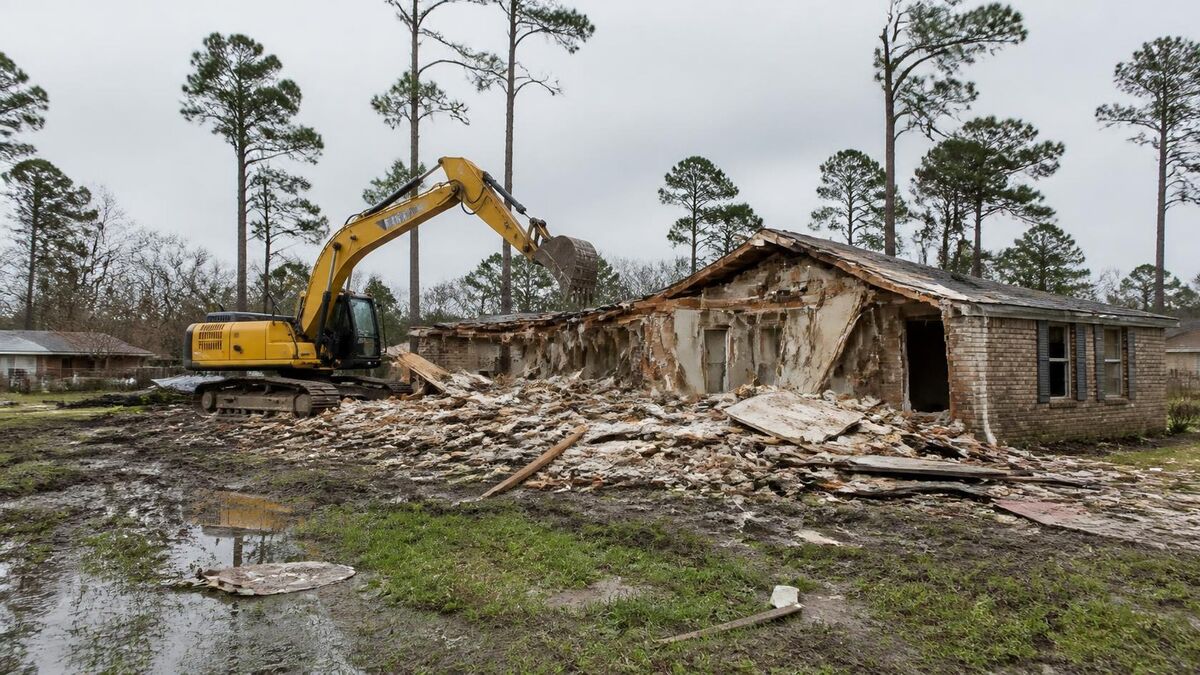
Why owners in the Capital Region decide to take a house down
Most teardowns here start with water. The August 2016 flood along the Amite and Comite rivers soaked thousands of homes, and some of the ones that were gutted, condemned or patched badly are still sitting on lots in Denham Springs, Central and the eastern side of the parish. For many owners, starting clean now beats elevating or rebuilding inside the old shell.
Other jobs have nothing to do with flooding. Infill buyers near downtown and the university often want the lot, not the tired cottage on it. Termite-eaten sills, a failed slab, fire, a hurricane-driven tree through the roof, or an inherited house nobody wants to fix can all end the same way. A condemned house may carry a city-parish deadline, while an infill teardown follows a builder's schedule.
The walk-through: how a contractor scopes the teardown
Nobody can price a house demolition from a photo. A contractor walks the property, measures the footprint, checks the slab edge or crawl space, and asks what the lot is for next, since a builder and a seller of bare land want different finishes. A good walk-through covers:
- Construction type: wood frame, brick veneer, block, or a mix added on over the decades
- Foundation: a slab-on-grade, a raised floor on brick or block piers, or both under one roof
- Access for an excavator and haul trucks, including gate widths, overhead power lines and soft ground
- Trees, fences, driveways and neighboring walls close to the work zone
- Visible suspect materials such as old siding panels, pipe wrap, floor tile or textured ceilings
- Where the gas meter, power drop, water meter and sewer cleanout sit
Asbestos and lead: the step that has to happen before anything else
Under state and federal environmental regulations, a structure is generally checked for asbestos ahead of demolition, and Louisiana's Department of Environmental Quality typically expects to be told about most teardowns in advance. That means an inspector approved by the state walks the house, takes samples of suspect materials, and writes up what was found. Mid-century houses are the usual suspects, though a remodel can hide old materials in a newer one.
If the survey turns up asbestos, an abatement specialist removes it before the machine work starts. That separate trade has its own containment and disposal rules, and the teardown waits for it. Paint on older siding, trim and windows may contain lead, which mostly affects how dust is kept down and how debris is handled rather than whether the house can come down. A proposal that skips the survey, or promises to sort it out later, is a proposal to walk away from.
Shutting off gas, power, water and sewer before the house comes down
A structure cannot be demolished with live service running into it. Each utility handles its own piece, and the order usually looks something like this:
- Call the gas company to shut off service and pull the meter; the line is cut and capped at the property side.
- Call the electric provider to disconnect the service drop and remove the meter, so no wire overhead or underground is energized.
- Have water service shut off at the meter and the house side line capped, unless the contractor needs a hose bib for dust control during the teardown.
- Have the sewer lateral cut and capped where the city-parish or your city wants it; many offices inspect that cap before signing off.
- Ahead of excavation, the contractor places a no-cost request with Louisiana 811 so crews come flag underground lines near the work.
The demolition permit and who reviews it
In East Baton Rouge Parish, the consolidated city-parish government issues demolition permits for most addresses. Cities such as Denham Springs, Zachary and Central keep their own permit offices, and the parish handles unincorporated ground in Ascension, Livingston and West Baton Rouge. Most of these offices hold the permit until you can show the services have been cut off and the asbestos inspection is complete.
Floodplain rules do not stop a demolition, but they shape whatever replaces it, so it is worth asking the permit office about elevation requirements for the lot before you sign a builder's contract. Subdivisions with an HOA may add covenants on noise hours, which streets haul trucks use, and how long a bare lot may stay empty. Community-specific notes live on the Baton Rouge, Denham Springs and Zachary pages.
Protecting the neighbors, the trees and anything that stays
Lots in the older parts of town can be narrow, with a neighbor's wall or carport a few steps from the house being removed. Careful contractors plan the teardown so material falls inward, away from property lines, and keep dust down by wetting the structure as it comes apart. Live oaks need extra care, since a loaded machine parked over shallow roots can cause damage that surfaces a year later. Common protective steps include:
- Temporary construction fencing around the work zone and any tree you want saved
- Plywood or timber mats over root zones, sidewalks and any driveway that stays
- Water spray during the teardown to keep dust off neighboring cars, windows and gardens
- A street plan for haul trucks so mud stays off the block
How the machine work usually unfolds on teardown day
With inspections, abatement, utility caps and the permit done, the teardown moves quickly. A tracked excavator with a thumb or grapple does most of it, pulling the structure apart from the top down and from the far side toward the access point. The general sequence:
- Salvage anything the owner wants kept, and pull loose contents the contractor agreed to handle.
- Remove the roof covering and any metal that can be scrapped separately.
- Pull the roof framing and walls inward with the grapple, wetting the pile as it grows.
- Sort the pile on the ground into wood, metal, brick and concrete, and general debris.
- Load trucks or roll-off containers as each stack fills, keeping the street clear.
- Break out the foundation, then remove driveways, walks or patios that are part of the scope.
Slab-on-grade houses versus older raised houses on piers
Homes around the Capital Region almost never have cellars, which leaves just two kinds of foundation to deal with. Most houses built in the last several decades sit on a concrete slab poured on grade, often with thickened edges and interior beams. Breaking that out takes a hydraulic hammer or a heavy bucket, and the reinforcing steel inside has to be cut free. An old slab rarely suits a new design or current elevation rules, so most builders want it gone.
Older raised houses, the kind common in neighborhoods near downtown and around older town centers, sit on brick or block piers with a crawl space underneath. Those piers and their footings are pulled out and the holes filled. Crawl spaces, though, collect old ductwork, pipe wrap and debris that all become part of the cleanup. A house that was raised after a flood may have newer, taller piers set in deeper footings, which changes the effort.
What happens to the debris after a house is torn down
Sorting a demolished house on site keeps disposal reasonable and recyclables out of the landfill. Typically:
- Concrete from the slab, steps and walks is often hauled to a crusher and recycled into base material
- Brick and block can go the same route when it is clean enough
- Metal roofing, ductwork, wiring, plumbing and rebar are separated and sold for scrap
- Lumber, wallboard, shingles, insulation and other mixed waste head to a landfill or transfer site that accepts building debris
- Any material identified as asbestos-containing leaves with the abatement specialist under its own disposal rules, not with the general debris
Backfill, grading and drainage on flat clay ground
When the house is gone, the lot is full of holes: the trench where the slab beams sat, pier footings, the old sewer line and any tree stumps pulled in the scope. Those get filled with suitable soil and compacted in layers, not just pushed in with a bucket. Heavy clay is the rule across much of the Capital Region. It holds water after a storm, shrinks and cracks during a dry spell, and settles unevenly if loose fill is dumped into a void. Compaction now prevents a sinkhole in the middle of a new driveway later.
Grading on ground this flat is about making water go somewhere. The finished lot should shed rain toward the street or a ditch rather than holding a puddle where the house stood, and it should not push runoff onto a neighbor. Erosion control matters too: silt fencing on the low side and straw or seed on bare soil.
How long a house teardown takes, start to finish
The machine work on a typical single-family house is often a matter of days, not weeks. The calendar around it is what stretches. The asbestos survey has to be scheduled and the lab results returned, abatement has to happen if anything is found, the state notice has to go in, each utility has to come out on its own schedule, and the permit office has to review the file. After heavy rain, clay can be too soft for loaded trucks. A contractor can give you a realistic picture after the walk-through, but nobody honest promises a date before the paperwork is moving.
A detached garage or shed out back usually comes down in the same visit; see garage and shed demolition. A backyard pool has its own fill questions, covered under pool removal. Browse every community on the service areas page, then email the address.
What a complete proposal contains and what drives the cost
The contractor prices the job after seeing it,: the size of the house, its construction type, whether it sits on a slab or piers, how easy the lot is to reach, whether asbestos or other hazardous material turned up, how much debris can be recycled, the utility work involved, how much fill and grading the lot needs, and the permit itself. A complete proposal should state, in writing:
- Exactly what comes down, including the foundation, driveway, walks and any outbuildings
- Who handles the asbestos survey, the state notice and any abatement
- Who arranges each utility disconnect and the sewer cap
- Which party files for the permit and books the last inspection
- How trees, fences and neighboring property will be protected
- Where debris goes and whether recyclable material is separated
- What fill is brought in, how it is compacted, and how the lot is graded and seeded
- What the lot will look like when the contractor leaves
Demolition company Baton Rouge owners call for a full house teardown — common questions
Is a demolition permit required to raze a Baton Rouge house?
Yes. Taking down a whole home requires approval from whoever has jurisdiction: the consolidated city-parish across nearly all of East Baton Rouge Parish, a municipal office in towns like Denham Springs or Zachary, or parish government outside city limits. Offices commonly want evidence of utility disconnects and a finished asbestos inspection first. The contractor usually pulls it, but get that in writing.
Is an asbestos inspection required before tearing down a house in Louisiana?
In most cases, yes. Environmental regulations at both the state and federal level generally call for that check ahead of any teardown, and Louisiana's environmental quality agency normally wants to hear about the job beforehand. An inspector approved by the state samples old siding, flooring, ceiling texture and pipe wrap. If asbestos turns up, an abatement specialist removes it before any machine arrives. Skipping the survey can stop a job cold.
Can I tear down a flood-damaged house and rebuild on the same lot?
Usually, but the new house will be judged by current floodplain and elevation rules, not the ones in force when the old one was built. Ask the permit office what the lot's flood zone means for floor height and fill before demolition. Some flooded properties went through buyout or grant programs, so confirm the lot's paperwork is clear before signing anything.
Can I salvage materials from my house before it is demolished?
Often, yes. Owners commonly pull cabinets, doors, old heart pine flooring, light fixtures, mantels and architectural trim before teardown day. Tell the contractor what you plan to keep so the schedule allows for it, and finish removal before the asbestos survey or abatement if those items might be affected. Anything left in the house once machine work starts generally goes out with the debris.
Will tearing down my house damage the neighbor's property?
It should not if the job is planned well. The structure gets pulled inward, away from property lines, wetted to hold down dust, and mats go under the machine where it crosses driveways or roots. On tight lots, the wall nearest a neighbor may come apart slowly or partly by hand. Ask how adjoining fences, walls and shared trees will be protected.
Should I tear down my aging house or fix it up?
That depends on what is wrong with it and what you want next. Sound framing on a solid foundation usually favors renovation. A failed slab, widespread rot, structural termite damage, repeated flooding or an unworkable layout can make repair cost more than replacement. Get a contractor's read on the structure, check the elevation rules for a rebuild, and compare both paths with real numbers.
Talk through your site
Start with the address, what needs to come down, and a few photographs of the structure and the access to it.
Related work
Garage and Shed Demolition
Detached garages, carports, sheds, barns and decks taken down and hauled off without rutting the yard.
Pool Removal
In-ground and above-ground pools broken out or filled in, with fill compacted so the spot can be used again.
Interior Demolition
Flood-damaged rooms, kitchens and baths gutted down to the studs, protecting what stays.
Concrete Removal
Cracked driveways, patios, walks and slabs broken up and hauled off, with the base ready for what comes next.
Across the metro
Baton Rouge
The city itself: older neighborhoods near downtown and the university, raised cottages and infill lots.
Prairieville
Fast-growing community to the south with newer slab houses, big lots, pools and shops.
Denham Springs
River city to the east hit hard by the 2016 flood, with gutted houses, raised rebuilds and old sheds.
Zachary
Northern community with acreage, barns, sheds and older farmhouses beside new subdivisions.