Home › Services
Garage and shed demolition across Baton Rouge and the Capital Region
A sagging detached garage, a shed the termites found first, a carport bent by a storm, or a barn that has outlived the farm it served: small structures cause big headaches when they start leaning toward the house or the property line. Taking one down sounds simple, and sometimes it is. Other times a power line runs to it, the only way in is across a soft lawn, or the slab underneath is thicker than anyone guessed. This page covers outbuildings of every kind around Baton Rouge, Prairieville, Denham Springs, Zachary and the rest of the Capital Region, including what to sort out before the work, how it gets done, and what your yard should look like afterward. Email us the details when you are ready.
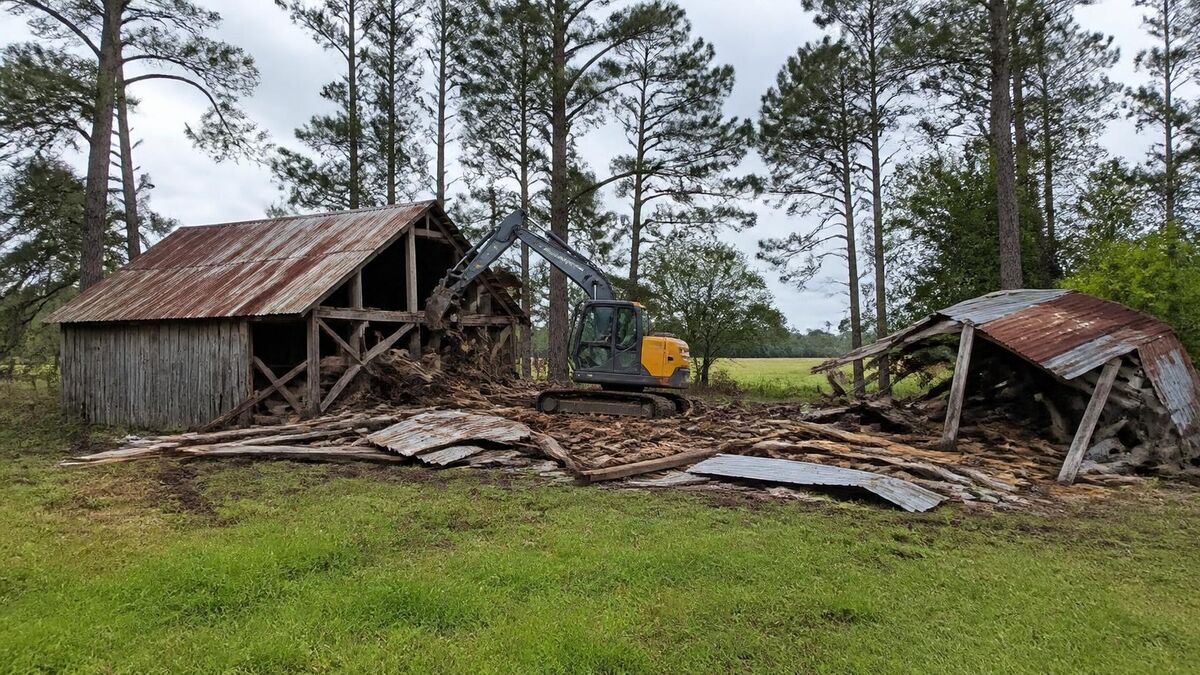
The kinds of outbuildings this page covers
Anything that stands apart from the main house, or leans against it without being part of its structure, belongs here. Around the Capital Region that covers a wide spread, from a prefab metal shed in a Prairieville backyard to a pole barn sitting on acreage north of Zachary. Typical jobs include:
- Detached one- and two-car garages, wood frame or block, with or without a workshop or loft
- Carports, both freestanding metal kits and older wood ones tied into the house roofline
- Wood, metal and vinyl storage sheds, including prefab buildings on skids or blocks
- Pole barns, equipment sheds, hay barns and old animal shelters on rural property
- Wood decks, including raised decks on posts and ground-level platforms
- Gazebos, pergolas, pavilions, playhouses, greenhouses and covered outdoor kitchens
Why these small buildings end up coming down
Wood structures in this climate fight a losing battle against humidity, termites and rot. A shed set directly on the ground or on a few concrete blocks wicks moisture into its floor framing year after year, and by the time the door stops closing, the sills are often soft. Detached garages from earlier decades were sometimes built with less care than the houses beside them, and many sat in water during the 2016 flood without anyone ever opening up the walls afterward.
Owners clear an old garage to make room for an addition, a pool, a new shop building or a wider driveway. Sellers take down an eyesore before listing. New owners of rural property inherit barns full of rusted roofing and old equipment. Storm damage or a code enforcement letter can also force the timing.
What to sort out before the demolition day
Empty the building yourself, or agree in writing on what the contractor will remove with it. Paint, fuel, pesticides, propane cylinders and batteries cannot go out with demolition debris, so they need their own disposal route first. Pull anything you want to keep, including fixtures, hardware, windows or old lumber you might reuse.
Power is the item people forget. Many detached garages and workshops have a circuit run from the house panel, sometimes overhead and sometimes buried in a shallow trench across the yard. Before any wall is pulled, an electrician needs to kill that feed at the breaker box and terminate it safely; the wrecking crew should not be the ones doing it. The same goes for a water line to a utility sink, a gas line to a shop heater, or a buried feed to a pool pump that passes through the garage. When digging is involved, the contractor should call Louisiana 811 so public utility lines get marked.
Hand demolition versus bringing in a machine
A small shed or deck can often be taken apart by hand with pry bars, saws and a trailer at the curb. That approach suits tight backyards, structures close to the house or a neighbor's property, and yards where a machine would do more harm to the lawn than the job is worth. It is slower but barely marks the ground.
A two-car garage, a block building or a large barn usually calls for a compact excavator or skid steer with a grapple. A machine pulls the structure down in a controlled direction, breaks out a slab, and loads debris quickly. The tradeoff is weight and access: tracks need a path in, and the path needs protecting. Many jobs blend the two, with workers stripping the side closest to the house by hand before the machine takes the rest.
Getting equipment into the backyard without wrecking it
Most garages and sheds sit behind the house, which means the route in crosses a lawn, a side yard, a gate or a driveway. Heavy clay soil turns soft after a good rain, and a loaded skid steer can leave ruts that hold water for months. A contractor should walk the access path with you and plan around these concerns:
- Gate and side yard width, and whether a section of fencing needs to come out temporarily
- Ground protection mats or plywood over the lawn, especially after wet weather
- Irrigation lines, landscape lighting wires and drainage pipes buried in the path
- Overhead service drops, cable lines and low tree limbs over the route
- Fragile features like patios, stepping-stone walkways and garden beds that sit near the route
- Whether the job should simply wait a few dry days before machines go in
Protecting the driveway, the house and the trees
A residential driveway was built to carry cars, not loaded dump trucks or roll-off containers. Thinner concrete, older asphalt and edges without much support crack easily under that weight. Ask where the truck or container will sit, and whether plywood or boards will go under container rails. A sensible contractor parks heavy loads on the street or on the strongest part of the slab and keeps the rest of the driveway clear.
Garages often sit within a few feet of the house, a neighbor's fence or a mature oak. The near walls can be pulled away from those features, and gutters, siding and windows nearby can be shielded. When a carport or covered patio is attached to the house, the connection points need care: the ledger board comes off the wall without tearing out siding, and the exposed area gets patched or flashed so rain does not get in behind it.
The slab or floor underneath: leave it or take it out
A typical detached garage, and plenty of bigger sheds, rests on poured concrete; lighter sheds tend to perch on runners, cinder blocks or pressure-treated posts. Whether to remove the slab depends on what comes next. A sound slab can host a new prefab shed, a sport court or a parking pad. A cracked, sunken or oil-soaked slab, or one in the spot where you want lawn or a pool, usually goes. Pulling it out adds breaking, hauling and fill to the job, and the proposal should list it as a separate line so you can decide. Deeper detail on breaking and hauling slabs lives on the concrete removal page.
Barns, pole buildings and outbuildings on rural acreage
North of Baton Rouge toward Zachary, and east into Livingston Parish, plenty of properties carry older barns and equipment sheds. These bring a different set of issues than a backyard garage. Posts are often set deep in the ground, sometimes in concrete. Old metal roofing comes off in long sheets that need careful handling. Lofts may still hold hay, feed, wire or decades of stored equipment that has to be cleared first.
Wildlife is part of the job too. Barns shelter wasps, snakes, raccoons and the occasional owl, so a good contractor looks before pulling the first board. Older siding and roofing panels on farm buildings sometimes contain asbestos, and environmental rules about inspecting before demolition can reach beyond houses, so ask whether a survey makes sense for the building in question. Scrap value from metal roofing and framing can be real on a large barn, and the proposal should say who keeps it. The Zachary page talks more about rural lots up that way.
Permits for smaller structures, in general terms
Rules vary by office. The city-parish handles most of East Baton Rouge Parish, while Denham Springs, Zachary, Central and other cities run their own permit desks, and the parish covers unincorporated areas in Ascension, Livingston and West Baton Rouge. Some offices want a demolition permit for any enclosed building, some only above a certain size, and some care mostly about whether utilities served it. A structure attached to the house, a garage with power, or anything in a flood zone is more likely to need paperwork.
Homeowner associations around Prairieville and other newer subdivisions may set their own rules about work hours, contractor parking and what can replace a removed building. The simplest move is to call the permit office for the address before scheduling, or to have the contractor confirm it as part of the proposal. Local notes are on the Prairieville and Denham Springs pages.
Hauling the debris and where it ends up
Small jobs often leave in a dump trailer or two. Larger garages and barns may call for a roll-off container set on the driveway or street for a few days. Either way, sorting on site keeps disposal reasonable:
- Metal siding, roofing, framing, garage doors and track are pulled out and sold for scrap
- Concrete from a slab, footings or block walls is hauled to a recycler that crushes it for base material
- Wood framing, shingles, drywall and mixed debris go to a landfill or transfer station that accepts construction waste
- Treated lumber from decks and posts is kept with general debris, never burned on site
What the yard looks like once the building is gone
Expect a bare rectangle of ground where the structure stood, a little lower or higher than the lawn around it. Post and pier holes are filled and tamped. If a slab came out, the area is filled with soil, compacted and graded so it drains with the rest of the yard rather than holding a puddle. Ruts along the access path are raked out.
Grass seed, sod and landscaping are usually not part of a demolition scope unless the proposal says so. New fill on clay ground can settle slightly over the first few rainy weeks, so a low spot may need a top-up. If you plan to build on the spot, tell the contractor early; ground that will carry a new structure may need better fill and compaction than ground that will only grow grass.
If the house is coming down too, the outbuildings usually go in the same visit, as the house demolition page explains, and a pool being filled where a shed will stand pairs with pool removal. Every community we cover is listed on the service areas page.
Price factors for a garage or shed, and the lines a fair bid includes
The contractor prices the job after seeing it. The biggest factors are the size of the structure, what it is built from, whether a slab or footings come out, how hard it is to reach, whether power or water ran to it, whether anything hazardous turned up, and how much debris needs hauling. A solid quote spells out:
- Which structures come down, and whether slabs, footings and posts are included
- Who handles the electrical disconnect and any other utility work
- How the lawn, driveway, house and trees will be protected
- What equipment will be used and the planned route into the yard
- Where debris and scrap go, and who keeps any salvage value
- How the ground is left: filled, compacted, graded, and whether seeded
Garage and shed demolition across Baton Rouge and the Capital Region — common questions
Will I need city-parish sign-off to remove a shed in Baton Rouge?
Sometimes. It turns on the shed's size, whether it had power or water, whether it touches the house, and which office covers the address. A small prefab shed on skids often needs little or nothing, while a detached garage wired to the house panel usually draws more attention. One call to the permit office, or a contractor who checks for you, settles it.
Who disconnects the electricity to a detached garage before it is demolished?
An electrician. The circuit feeding a detached garage or workshop normally starts at the house panel, so it must be shut off and terminated there before anyone pulls a wall. Some demolition contractors line up the electrician; others expect the owner to. Either way, confirm the line is dead and that the buried or overhead feed will be removed.
Will tearing down my garage crack my driveway?
It can if loaded trucks sit on thin or aging concrete. The risk drops when dump trucks stay on the street, roll-off containers rest on boards, and full loads cross the driveway as rarely as possible. Older asphalt and unsupported slab edges break first. Point out existing cracks before work starts so everyone agrees on the starting condition.
Can I tear down my own shed and have someone else haul the debris?
Plenty of owners take apart a small wood shed on skids themselves. The surprises are usually the floor framing, anchors, concrete underneath and the sheer pile of debris. If there is a slab, wiring, an older roof that might hold asbestos, or a wall close to the house, handing the whole job to a demolition contractor tends to work out better.
How do you get equipment into a fenced backyard?
Through the widest gate if it fits; otherwise a fence panel comes out temporarily and goes back afterward. Compact track loaders squeeze through surprisingly narrow openings, and mats keep them from rutting soft lawn. Where no path works at all, the structure is taken apart by hand and carried out in pieces, which is slower but leaves the yard nearly untouched.
What can I put in the spot after a garage or shed is removed?
Almost anything, if the ground is prepared for it. Lawn or a garden bed needs decent topsoil and grading. A prefab shed or parking pad needs firm, compacted fill. A new garage, addition or pool needs its own permit, and floodplain rules for the lot still apply. Share your plans early so the final fill and compaction match the load.
Talk through your site
Start with the address, what needs to come down, and a few photographs of the structure and the access to it.
Related work
House Demolition
Full teardown of a house down to a clean lot, with the slab or piers removed and utilities handled first.
Pool Removal
In-ground and above-ground pools broken out or filled in, with fill compacted so the spot can be used again.
Interior Demolition
Flood-damaged rooms, kitchens and baths gutted down to the studs, protecting what stays.
Concrete Removal
Cracked driveways, patios, walks and slabs broken up and hauled off, with the base ready for what comes next.
Across the metro
Baton Rouge
The city itself: older neighborhoods near downtown and the university, raised cottages and infill lots.
Prairieville
Fast-growing community to the south with newer slab houses, big lots, pools and shops.
Denham Springs
River city to the east hit hard by the 2016 flood, with gutted houses, raised rebuilds and old sheds.
Zachary
Northern community with acreage, barns, sheds and older farmhouses beside new subdivisions.